
Monday, March 13, 2006


Orca sighted at Kelp Reef!
Capt. Trev was bringing the Super Cat down Haro Strait at 4:15 PM. A warm breeze was upon the water and most of our company were up on the top deck talking about Orca natural history. I was scanning the shoreline below Mt Douglas, having just mentioned that side of the strait as being seemingly preferred by transient Orca when much to my surprise I saw a blow and fin about a half mile away! I shouted out "BLOW!" and pointed as Trev reduced speed. T 19B Dorsal. Credit: Jim Maya

Green Point Steller Sea Lions
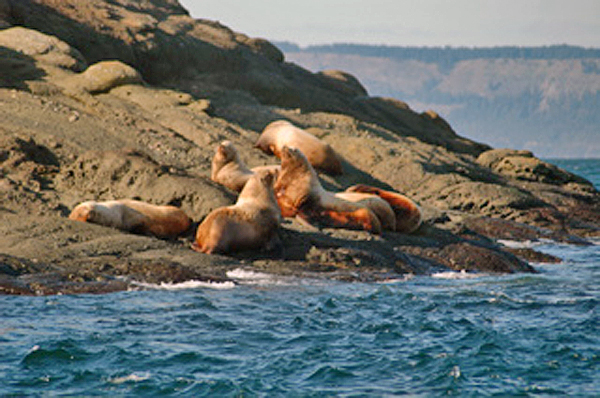
Each fall Steller Sea Lion males return to the protection of the inside waters. In spring the males return north to seek out the females. At Green Point we saw several large sea lions both "rafting" in the water and sunning themselves on the basalt rock shore. Learn more about Steller Sea Lions @

http://stellersealions.noaa.gov/

Green Point, Spieden Island, San Juan Group WA
A early spring hangout for Steller sea lions, green point is just a few miles north of Friday Harbor, San Juan Island.

Mouflon sheep, Sitka and Fallow deer.
In the 1970's a group of game hunting taxidermists in Seattle purchased the island and stocked it with exotic herd animals like Japanese Sitka Deer, European Fallow deer and the Corsican Mouflon sheep (Ovis musimon). The Mouflon is thought to be one of the two ancestors for all modern sheep breeds. Found in Corsica, it is red-brown with a dark back-stripe, light colored saddle patch and under-parts. The males are horned and the females are horned or polled. It is now rare but has been successfully introduced into central Europe, including Germany, Austria, Czech Republic, Slovak Republics, Romania and of course Spieden Island.
The island is still private but hunting was suspended long ago and today we saw the idyllic life of these beautiful exotic animals as they grazed the grassy slopes above the shore.

The island is still private but hunting was suspended long ago and today we saw the idyllic life of these beautiful exotic animals as they grazed the grassy slopes above the shore.
Spieden Island, San Juan Group WA
We crossed Haro Strait heading NNW and entered the San Juan group around 3PM skimming past the empty cormorant nesting cliffs of Kellit Bluff at 23 knots. We had only a brief sighting of a Dall's Porpoise near Kelp reef and were hoping to encounter Sea Lions near Spieden Island.

Sunday, March 12, 2006
First stop the Chain Islets
Our first stop after passing Trial Island Lighthouse was the Chain Islets. Right away we sighted one adult and one young Bald Eagle. A young man from Toronto spotted couple of Black Oystercatchers gliding in along the waters edge. The young raptor was sitting on top of the main Cormorant nesting site. The eagles own Great Chain and are looking forward predating on the cormorants young in a few months time. The islets are best described here:
The Chain Islets and Great Chain Island are located in Oak Bay, in the Juan de Fuca Strait, less than 2 km from the suburbs of Victoria, British Columbia. The site includes a cluster of at least 18 small islets and rocks in Mayor Channel. The low round islets are rocky and barren except for Great Chain Island that supports a nearly continuous grass and herbaceous cover and occasional shrub thickets. Shoreline features include a few steep faces, rocky outcroppings, boulders, crevices and small gravel beaches. The islets are surrounded by shallow water from which many rocky reefs emerge. Harbour Seals are regular in summer and the natural Gulf of Georgia meadow habitat, which has been eliminated by disturbance from most sites in British Columbia, supports rare flora such as Golden Indian Paintbrush, California Buttercup and Snakeroot Sanicle.
Birds
Chain Islets and Great Chain Island is a site of global importance, supporting a significant breeding population of Glaucous-winged Gulls, and a migratory population of Brandts Cormorants.
Additionally, 510 pairs of Double-crested Cormorants, which in British Columbia nest only in the Strait of Georgia, were recorded nesting in these islets. This is the second largest colony of this species in the province. Pigeon Guillemots and American Black Oystercatchers also nest on the islets, and Harlequin Ducks occur seasonally among the reefs and islands.
To learn more about this jewel in Victoria's crown check out this web site. http://www.bsc-eoc.org/iba/site.jsp?siteID=BC045
After leaving Oak Bay, we passed 10 Mile point and started our crossing of Haro Strait.
The Chain Islets and Great Chain Island are located in Oak Bay, in the Juan de Fuca Strait, less than 2 km from the suburbs of Victoria, British Columbia. The site includes a cluster of at least 18 small islets and rocks in Mayor Channel. The low round islets are rocky and barren except for Great Chain Island that supports a nearly continuous grass and herbaceous cover and occasional shrub thickets. Shoreline features include a few steep faces, rocky outcroppings, boulders, crevices and small gravel beaches. The islets are surrounded by shallow water from which many rocky reefs emerge. Harbour Seals are regular in summer and the natural Gulf of Georgia meadow habitat, which has been eliminated by disturbance from most sites in British Columbia, supports rare flora such as Golden Indian Paintbrush, California Buttercup and Snakeroot Sanicle.
Birds
Chain Islets and Great Chain Island is a site of global importance, supporting a significant breeding population of Glaucous-winged Gulls, and a migratory population of Brandts Cormorants.
Additionally, 510 pairs of Double-crested Cormorants, which in British Columbia nest only in the Strait of Georgia, were recorded nesting in these islets. This is the second largest colony of this species in the province. Pigeon Guillemots and American Black Oystercatchers also nest on the islets, and Harlequin Ducks occur seasonally among the reefs and islands.
To learn more about this jewel in Victoria's crown check out this web site. http://www.bsc-eoc.org/iba/site.jsp?siteID=BC045
After leaving Oak Bay, we passed 10 Mile point and started our crossing of Haro Strait.
Five Star Whale Watching Spring Transient 2006
4:30 PM March 11th 2006; Haro Strait - Kelp Reef - San Juan Island. Our first Super Cat trip of the year was very exciting! Capt. Trev, researcher Ron and I (naturalist-Jeff) we're really happy to be getting out on the water so soon this year. The Supercat departed Victoria Harbour with a dozen intrepid Canadian and Bosnian travelers looking for marine
wildlife. As usual, while I briefed the passengers on
the Catamaran's safety features Capt. Trev and Ron discussed the latest sightings in the past week and planned our route. Ron had knowledge of Resident Orca pods L-12 and K heading north up Swanson Channel the previous afternoon. He also knew there were Steller Sealions in the vicinity of Green Point on Spieden Island. We set out into light north easterly winds and warm sunshine.

wildlife. As usual, while I briefed the passengers on
the Catamaran's safety features Capt. Trev and Ron discussed the latest sightings in the past week and planned our route. Ron had knowledge of Resident Orca pods L-12 and K heading north up Swanson Channel the previous afternoon. He also knew there were Steller Sealions in the vicinity of Green Point on Spieden Island. We set out into light north easterly winds and warm sunshine.
Saturday, October 22, 2005
2005 5 Star Season closes

Well it's hard to believe it but it's been approximately 8 months on the water and it's time to put the boat to sleep for a while. Soon our orcas will leave the area in search of salmon perhaps offshore, north or south. In the mean time, researcher Ron Bates and myself will keep in touch with what animals are in our area and do our best to provide land based coverage so do check back here soon!
See you all next year. And we all know how fast that time will pass and then it will start all over again, I CAN'T WAIT!. It's been an amazing experience. There is NOTHING more amazing then this, life just can't be more incredible.
Thanks to all of the 5 star crew. You've made many dreams come true :)
Thursday, October 06, 2005
J, K, L pods / South San Juan Island


It was raining today but flat calm out on the water. We traveled east to where most of the southern residents were feeding - most of them had traveled down Rosario Strait. We arrived to find most of the animals spread far apart individually, maybe in two's and sometimes three's. They were situated all the way from the shoreline of south San Juan Island out into the middle of the strait.
Soon after arriving, we were graced by a mother and calf who passed by our bow very close. We saw L74 / Saanich and L79 / Skana as both of them individually passed close by as well. We also caught a social moment as a male spy hopped approximately 200 yards from our bow. For the most part the animals stayed in a feeding pattern throughout our trip. The dark skies and waters made for excellent photographic contrasts. Fall is definately here. It's amazing to think that we have been out on the water 8 months now. Time sure flies when your having fun :)
Tuesday, October 04, 2005
Lpod / San Juan Island


This afternoon we traveled east to San Juan Island. We arrived and found mainly Lpod foraging near False Bay individually and in small groups. We were pretty lucky to see some calfs this time around - one that we think is L67 and calf L101 Aurora (L98 / Luna's brother). We also saw L72 / Racer as well as L57 / Faith hunting in the distance. Saw several small groupings of 3-5 animals. Some very social behavior by the jouveniles and calfs including one very close inspection of our boat. You can see the white outline pass below the bow of the boat and see the calf rolled over on it's side looking at us from under the water.
Saw a calf playing with kelp - had it drapped over it's head and through the mouth. Breaching, tail lobbing, belly rolls and other interesting social behaviors were displayed. Near the end of our trip, a small group consisting of a calf, mother or sister and big brother (pre jouvenile male) were playing right at our bow. Mom sat in the water just watching the calf and male play. Nothing could prepare us for the large head stand he would do right infront of our bow, and twice! It was spectacular - something i've not seen before. Then the baby appeared spyhopping and pec slapping at their larger family mate. It was an incredible treat.

Saturday, October 01, 2005


Subscribe to:
Posts (Atom)