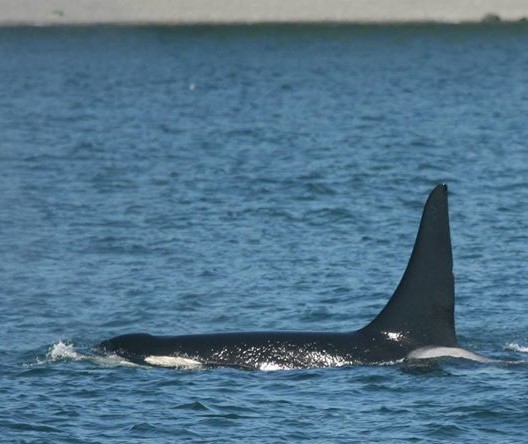
On July 14th we celebrate World Orca Day!
We are lucky in the Salish Sea to encounter two eco-types of Orcas, Resident (fish eating) and Bigg's (marine mammal eating) Orcas.


What is a pinniped? Well, pinnipeds include true seals, Sea lions and walruses. Can you think of any pinnipeds that we have on the West Coast of B.C.? This Wildlife of the Week focuses on one known as the Harbour seal (Phoca vitulina). This is a charismatic and adorable species that frequents these shorelines. Have you seen a Harbour seal before? Share where you’ve spotted this species in the comments below!
Harbour seals typically measure between 3-6 feet and weigh up to 285 pounds, but some subspecies may be larger or smaller than others. Harbour seals do not have large fore-flippers unlike their Sea lion relatives.
They range in colour from grey, silver, tan and brown. This species of seal is usually dark with light rings or light with dark spots.
Harbour seals are found in many northern and temperate oceans around the world, but different subspecies are believed to exist (i.e. at least five). They can be distributed along the Eastern and Western coastlines of North America, the Bering Sea and northern seas of Asia and Europe.
Harbour seals have even been seen to frequent or remain in freshwater areas.
Harbour seals are carnivores, preying on a multitude of seafood items. Their prey includes fishes (e.g. rockfish, hake), crustaceans (e.g. crabs) and molluscs (e.g. squid, octopus). They forage and hunt underwater. They can dive for up to 30-40 minutes and to maximum depths of 400m.
Harbour seals stay warm due to a thick layer of blubber (fat) that shields them from the cool ocean, and even glacial ice. They “haul out” on shorelines, rocky outcroppings and ice in order to rest, thermoregulate, molt, give birth and nurse and escape from predators.
Harbour seals are important members of the food web, contributing to the survival of several predators, most namely Bigg’s Killer Whales in the Salish Sea.
How much do you know about Harbour seals? Here are a few trivia questions to test your knowledge!
BONUS CHALLENGE: What are the main differences between a true seal (like a Harbour seal) and a Sea Lion?
ANS: True seals have no external ear flaps, have shorter front flippers and cannot move their back flippers in the forward direction.
Learn more about Harbour seals from the References below:
Deecke, V., Slater, P. & Ford, J. Selective habituation shapes acoustic predator recognition in harbour seals. Nature 420, 171–173 (2002). https://doi.org/10.1038/nature01030
“Harbour Seals.” Capital Regional District. https://www.crd.bc.ca/education/our-environment/wildlife-plants/marine-species/harbour-seals.
“Harbor Seal.” NOAA Fisheries. National Oceanic and Atmospheric Administration. U.S. Department of Commerce. https://www.fisheries.noaa.gov/species/harbor-seal.
Words: Five Star Whale Watching
Through the challenging months of the pandemic, Five Star has remained committed to providing educational tools, advocacy resources and hope through nature to the community. Through our willingness to preserve, remain strong and support our friends and partners, we have accomplished resiliency and adaptation in the last months.
As always, our commitment to educate and foster love for the marine environment remains at the core of our business – from celebrating World Oceans Day, World Environment Day and Earth Day digitally, to sharing our past experiences on the water with the public, we recognise just how special it is to have the involvement with the marine environment which we do. To our excitement, a photo of ours was featured in a CTV News Article discussing ocean recovery. Five Star was also thrilled and humbled to welcome an award for “Leading Pioneers for Marine Eco-Tourism-British Colombia” from Business Excellence Awards this June. We remain committed to respecting our fellow neighbours and citizens of this planet, and vow to promote kindness and inclusion in all that we do.
This month is Orca month, and we’ve been active with promoting actions from organisations such as the Centre for Whale Research. They are continuing important work in their fight for the Southern Resident Killer Whales and the recovery of their prey, Chinook Salmon.

As we have not been able to physically explore our beautiful marine environments, we have been helping our digital community to explore and learn about these areas and species virtually with an active social media presence. With virtual wildlife clips and weekly social media events such as #WhaleWednesday and #WildlifeoftheWeek, we are constantly evolving to provide interesting and educational content in our missions to help the ocean. We ourselves have been active with following sightings reports (although limited for all right now) to stay informed and bring the current state of wildlife to eager listeners.
Issues in our region threaten the well-being of our natural environments. We recently voiced concern over the proposed extension of the Deltaport in the heart of the Fraser River estuary, that would hinder an already at-risk ecosystem. We remain passionate about educating others in the reality and benefits of educational and respectful whale-watching. We remain focused on promoting facts regarding the current status of the Southern Resident Killer Whales and the contrast between them and the thriving Biggs’ Killer Whales and Humpback Whales. We look forward to operating again on the water and work to grow our educational and conservation message through the evolution of all means listed above.
Find out more about Five Star Whale Watching on their website: https://www.5starwhales.com/


Wildlife of the Week.
We hope that you have been enjoying our Wildlife of the Week series! We have been truly enjoying sharing some incredible Salish Sea creatures with you. Our fourth Wildlife of the Week spotlight focuses on a fascinating species of Baleen whale. Check out the photo of this whale- does the species look familiar? It is not a Humpback Whale, which is another Baleen whale seen on this coast. Hint: this whale is a slender, fast swimmer with the ability to reach speeds up to 32 km/h.
…..The Minke Whale is the smallest member of the Rorqual family, yet this species still measures between 26-33 feet long! Scientists think that there might be at least 2 or 3 species of Minke Whale in the world (Balaenoptera acutorostrata, Baleonoptera bonaerensis are recognized scientifically), as well as further subspecies.
The Minke may be found in all oceans of the world, yet they tend to favour cold, northern waters of the world.
The Minke Whale, like other Baleen whales, does not have teeth and instead uses baleen plates to filter out their prey from the water. Numbers of baleen plates may vary between Minke Whale species/subspecies. Prey includes crustaceans like krill and fishes (often schooling fishes).
Baleen is made of keratin and is a hair-like material found on the top jaw of the whale’s mouth. It acts as a filter to sieve out the small creatures when the whale takes in (and then releases) large gulps of seawater.
In some regions, the Minke Whale is migratory whereas in others the animal remains in a region year-round.
Minke Whales of the Antarctic species do not have the white band seen on the flippers of other Minke Whales. The Minke’s dorsal (top) surface is typically a brown or black-grey color, with lighter greyish sides and a white belly. Different species/ subspecies have also been observed to show slightly different coloration patterns and body sizes.
Females are larger than males, and produce calves about every two years; they have a gestation period of about 10-11 months.
Who would like to test out their Minke Whale knowledge? Try out some trivia below!
In the Salish Sea and some other regions around the world, what is a known predator of the Minke? Hint: It is another type of marine mammal. (ANS: KILLER WHALE/ ORCA).
True or False? Minke Whales nurse for over 1 year. (ANS: FALSE. They only nurse with their mothers, weaning at about 4-6 months).
True or False? Minke Whales may dive for up to 15 minutes. (ANS: TRUE).
BONUS CHALLENGE: Minke Whales are often coined the nickname “Stinky Minkes”. Do you know why?
(ANS: They are extremely difficult to observe/ watch as they are very surface-shy. The whale also has been recorded to have terrible breath due to bacteria living in their respiratory tract).
Want to know more about the Minke? Check out our References:
“Minke Whale.” 2019. American Cetacean Society. https://www.acsonline.org/minke-whale.
Our friends at the World Cetacean Alliance created this wonderful video about Five Star Whale Watching. We are proud to be Victoria’s first WCA Certified Responsible Whale Watching Operator.


It’s week three of Wildlife of the Week, and it’s landed on a special day- Father’s Day! This Father’s Day we have decided to highlight a special marine mammal that we are sure many of you have heard of before... ...the Killer Whale! Killer Whales are also known as orcas, and there are various ecotypes of orcas on this coast. If anyone has ever seen orcas in the wild, you might have noticed that some adults have tall dorsal fins, and some do not. Does anyone know why this is?
The answer is that adult males have tall and straight dorsal fins whereas females have shorter, curved fins. Take a look at this image of an adult male orca named L41, or “Mega”. This Father’s Day we reflect on this remarkable whale, who was a father to many Southern Resident Killer Whale calves throughout his life.
Orcas are the largest member of the dolphin family. They are an agile, social and intelligent marine mammal. Orcas can be spotted in all Earth’s oceans, although they are most frequent in temperate and cool regions. Adult males may measure up to 32 feet long!
L41 is believed to have fathered 14 calves that survive to this day. L41, his family, his mates and his children would all belong to the fish-eating ecotype of orcas in the Salish Sea that feed primarily on Chinook salmon (the SRKW’s).
L41 and the SRKW’s do not appear to have a consistent breeding or birthing season, but breeding can often be observed during socializing and “reunions”.
Adult male orcas, like L41 was, do not assist in raising their own young but often assist with the care of younger whales, namely their siblings or the offspring of female siblings.
Orcas are almost always seen in family groups. In orca societies males typically stay with their mothers their entire lives. L41’s mother was L11. He was seen by her side until his disappearance and presumed death in early 2020.
A reason that we can tell L41 and his family apart (as with many other researched orcas), is mainly due to the individual distinctions between the whales. Dorsal fin shapes and sizes, saddle patches (behind dorsal fin) and eye-patch patterns can help us to identify one orca from another, as well as one family and ecotype from each other.
Orcas communicate in different dialects between pods and ecotypes; this can also assist in identifying a group.
Other ecotypes of orcas feed on seals, Sea lions, porpoise, dolphins, baleen whales, herring, penguins, sharks and squid; the orca has no natural predator in the oceans.
In remembering L41, it is also important to remember how critically these whales depend on the drastically reduced Chinook salmon populations. The SRKW’s are an endangered group of whales in contrast to the Biggs’ orcas of the Salish Sea. The latter population is thriving due to the abundance of seals and Sea lions. Five Star is passionate about advocating and supporting the recovery and protection of all populations of these amazing orcas.


Welcome to Week 2 of Wildlife of the Week! We’ve decided to highlight an animal that lives deep under the waves of the Salish Sea. There is a general name for this animal that includes multiple species. Does anyone know this creature from the photo above? Here are a few clues if you need a hint:
(i) It is not a lobster, contrary to its name.
(ii) Its claws may be twice as long as its body
….if you guessed Squat lobster, you would be correct! A common species seen in B.C. is called Munida quadraspina.
The Squat lobster is a small crustacean that is an important member of marine communities, with many species found in the deep-sea. They can measure from less than 1 cm to a maximum of 9 cm long.
They are related to other crustaceans like shrimp and hermit crabs.
Squat lobsters are often spotted dwelling in enclosed spaces. You might spot one between rocks and boulders, as they hide from fish predators. They may also use their claws to guard their space…however they can swim and walk around on surfaces.
They may also be spotted sitting atop varieties of corals, sponges and other marine structures.
This tiny creature is commonly known to feed on small plankton, shrimp and organic matter, usually scavenging or sorting through sand. However, some have been seen hunting live fish on reefs!
These creatures are bright in shades of orange and red.
Regarding Munida quadraspina, they can be found from Alaska to California between depths of 12-1400m.
Now, time for trivia! See if you can answer all the questions below:
BONUS CHALLENGE:
The squat lobster has what is called a “tail fan”. This is extremely important to the animal for a major reason…do you know what it is?
Answer: It is used as an escape mechanism and allows the creature to swim backwards.
Would you like to learn more about this interesting underwater crustacean? Check out our References to learn more!
Baldwin, Aaron. “Infraorder Anomura (Mole crabs, Hermit crabs, King crabs, Porcelain crabs, and Squat lobsters) of British Columbia.” Klinkenberg, Brian. (Editor) E-Fauna BC: Electronic Atlas of the Fauna of British Columbia [www.efauna.bc.ca]. Lab for Advanced Spatial Analysis, Department of Geography, University of British Columbia, Vancouver. [13 June, 2020].
Cowles, Dave. “Munida quadraspina Benedict 1902. 2005.” Invertebrates of the Salish Sea. Walla Walla University. https://inverts.wallawalla.edu/Arthropoda/Crustacea/Malacostraca/Eumalacostraca/Eucarida/Decapoda/Anomura/Family_Galatheidae/Munida_quadrispina.html
“Squat lobster.” Monterey Bay Aquarium. 2020. https://www.montereybayaquarium.org/animals/animals-a-to-z/squat-lobster
“Are squat lobsters really lobsters?” Ocean Exploration and Research. National Oceanic and Atmospheric Administration. https://oceanexplorer.noaa.gov/facts/squat-lobsters.html